en
 Български


SubTotal: 00.00 BGN
This site uses cookies to help give you the best possible user experience. By continuing to browse this site you give consent for cookies to be used!
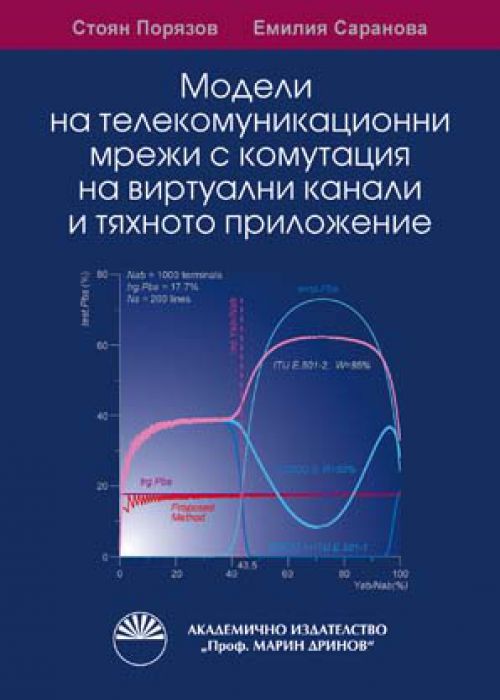
Models of telecommunication networks with virtual circuit switching and their application
Stoyan Poryazov, Emiliya Saranova
10 item(s) in stock
Year of Publication: 2012
Cover Type: Soft
Category: Informatics
Edition: First Edition
Pages: 238
Format: n/a
Language: Bulgarian
Summary
A significant problem in the design, management and operation of modern telecommunication networks is the quality of service. This is especially true for subscriber access networks, where transmission resources, for example the radio frequency spectrum, are generally limited or are built slowly and are expensive. On the other hand, the needs for multimedia traffic using modern and promising terminals, including mobile ones, are growing rapidly. The main method for ensuring quality of service is the reservation of resources. In practice, this is expressed in the reservation of virtual channels in relevant virtual networks (VNETs) to guarantee the quality of service of the highest priority traffic. Traffic with a lower priority uses the dynamically released resources from higher priority traffic. This paper describes a comprehensive traffic model of telecommunication networks with virtual channel switching, taking into account in detail the behavior of users, as well as the relevant conceptual and analytical models. Numerical experiments have been carried out using the developed computer programs and the most important dependencies have been illustrated. The scientific objective of the monograph is a description of the developed methodology for sizing and resizing networks, so as to guarantee the quality of service for traffic with the highest priority – class 0 traffic, which is carried out in real time, is sensitive to jitter and has high interactivity (e.g. in video teleconferencing). This work is intended for use by researchers, designers, traffic managers, doctoral candidates, graduate students, students and all those who work in the field of teletraffic theory, teletraffic engineering and network planning. The main purpose of publishing the scientific work is to improve the conditions for training specialists, which can increase the competitiveness of the business sector. The conceptual models and some results in Chapters One and Two were developed by Stoyan Poryazov.
About The Authors


Specifications
ISBN: 978-954-322-540-8
DOI: n/a
Year of Publication: 2012
Category: Informatics
Edition: First Edition
Language: Bulgarian
Cover Type: Soft
Pages: 238
Weight (kg): 0.310 kg
Format: n/a
Width (mm): /n/a
Height (mm): /n/a
Тhickness (mm): /n/a
Recently Viewed Books