en
 Български


SubTotal: 00.00 BGN
This site uses cookies to help give you the best possible user experience. By continuing to browse this site you give consent for cookies to be used!
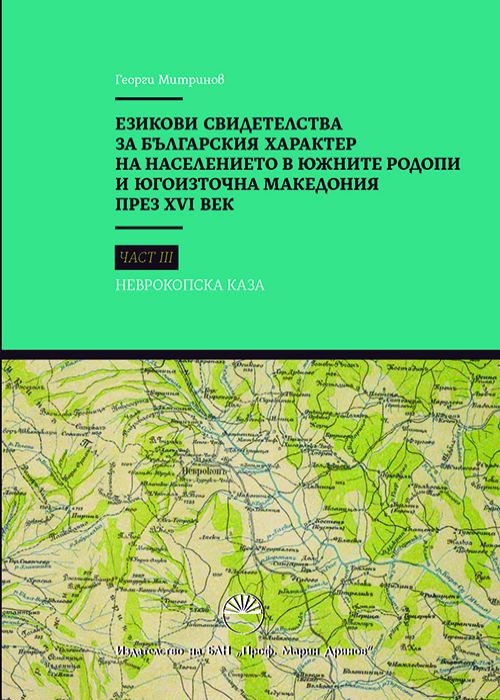
LANGUAGE EVIDENCE FOR THE BULGARIAN NATURE OF POPULATION IN SOUTHERN RHODOPES AND SOUTHEAST MACEDONIA IN THE XVI CENTURY
PART III. KAAZA NEUROKOP
Georgi Mitrinov
10 item(s) in stock
Year of Publication: 2024
Cover Type: Soft
Category: Linguistics
Edition: First Edition
Pages: 408
Format: n/a
Language: Bulgarian
Summary
This work, as the third part of the study devoted to Bulgarian linguistic traces in the White Sea region and the Southern Rhodopes in the 16th century, presents anthroponymic and oikonymic data on the Bulgarian Christian population in the former Nevrokop district, found in Ottoman tax registers dated 1569–1570. The territorial unit of Nevrokopska kaza includes parts of the Southwestern Rhodopes (now Gotse Delchev), including the region of Chech, as well as the areas of South Pirin, Zernevsko Pole, and the Belotinska Valley. It also includes part of the historical-geographical region of Mervashko. The last three areas, as well as the southern part of the historical-geographical region of Chech, along with part of the historical-geographical region of Mervashko, are now part of Greece due to political circumstances. The settlement network in Nevrokopska kaza includes nearly 120 settlements with a Bulgarian Christian population. The study presents interesting linguistic data about it. A comparison has been made with anthroponymic material from the Southern Rhodopes and Western Thrace; from the Rupchos region in the Central Rhodopes, according to data from the 16th century, as well as with anthroponymy from the 15th century from various parts of the Bulgarian ethnic territory. The work will be of interest to Bulgarian and foreign researchers: linguists, historians, ethnologists, as in addition to strictly linguistic (mainly anthroponymic and oikonymic) data, it includes information about the material and spiritual culture of the Bulgarian Christian population in the described areas. The facts will also be useful for the descendants of the numerous Bulgarian refugees from the areas mentioned: the Zernevo field, the Belotina valley, and the historical and geographical regions of Mervashko and Chech, who are interested in their Bulgarian family history.
Аbout The Author
Specifications
ISBN: 978-619-245-449-4
DOI: n/a
Year of Publication: 2024
Category: Linguistics
Edition: First Edition
Language: Bulgarian
Cover Type: Soft
Pages: 408
Weight (kg): 0.474 kg
Format: n/a
Width (mm): /n/a
Height (mm): /n/a
Тhickness (mm): /n/a
Recently Viewed Books